CADBase is an open-source platform for managing catalogs of components from industrial enterprises and design bureaus.
Unlike proprietary and expensive systems or general-purpose tools like Git and cloud drives, which don't account for the specifics of engineering data, CADBase already includes storage, versioning, and publishing of components.
The platform can be configured for an internal parts catalog or public distribution of components, depending on the team's needs.
The CADBase platform has been under development since 2018. The name combines two words — CAD and Base — forming "CADBase". It describes the platform as "CAD Data Base".
CADBase's main task is to provide exchange of 3D models, drawings and related information: supporting documentation, manufacturers' catalogs with information about suppliers, certificates, standardization and classification documents.
The idea of sharing project access across different CAD systems is not new, and there are already solutions for integrations between CAD, PLM and SCM. From a business point of view, the CADBase platform is focused on manufacturing enterprises and engineering companies. In the future, the use of the platform will simplify the process of searching for suppliers and selecting analogs, allowing potential customers to quickly receive information about the manufacturer and its products.
The CADBase platform implements the principles of a Common Data Environment (CDE), serving as a centralized "single source of truth" for projects. This means all participants work with the latest versions of models and documents stored in a unified data space, regardless of the systems they use. This approach reduces errors and simplifies collaborative work.
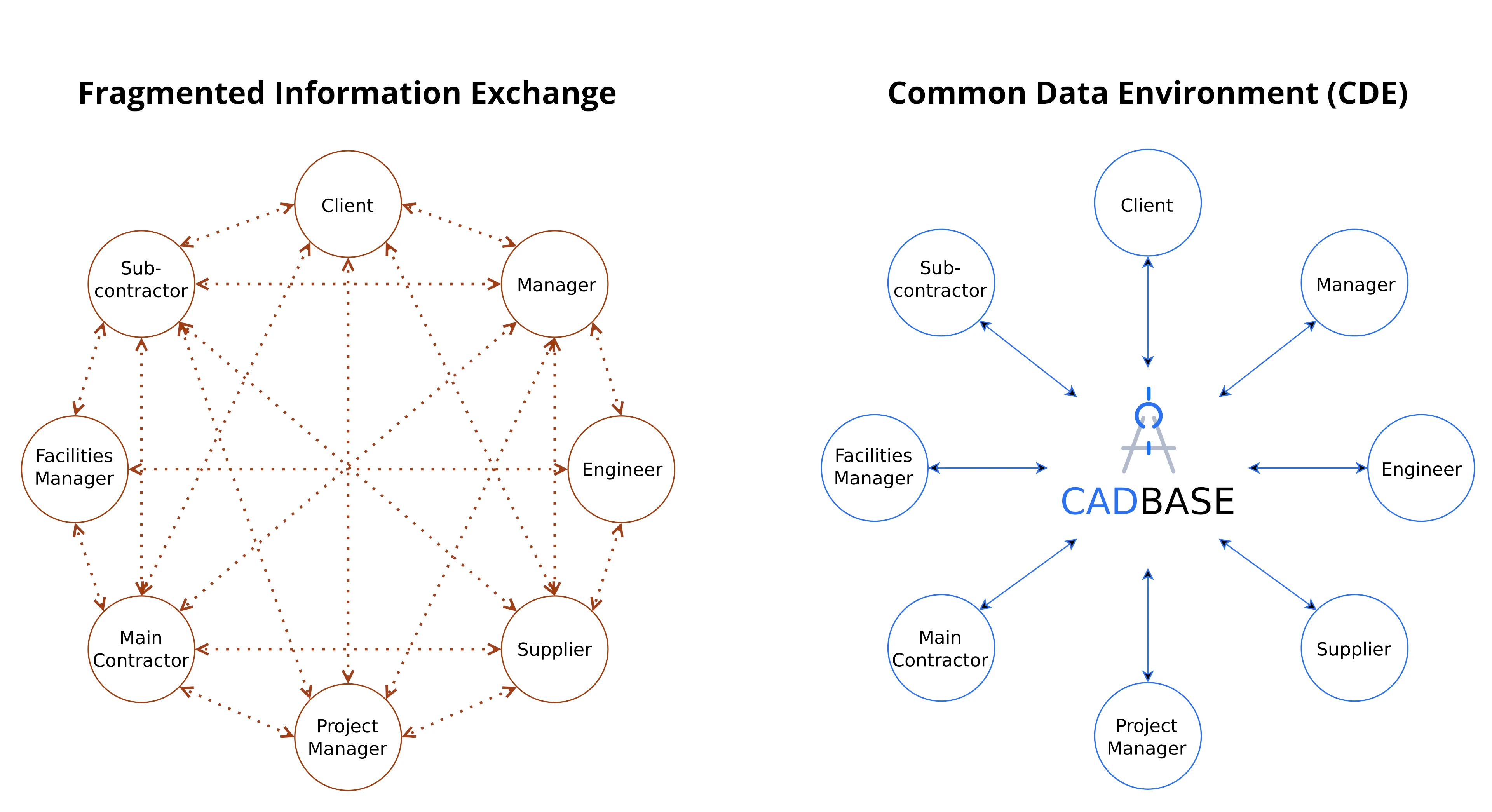
Interaction in Common Data Environment (CDE)
The platform launched in January 2022 with a minimal feature set. The main users of the platform are people who need external storage for their engineering work — those who find cloud drives insufficient and want model catalogs, a 3D viewer, and file version control. Taking into account user requests, integrations with FreeCAD (a free parametric CAD program) and Blender 3D (a free program for creating 3D computer graphics) were implemented.
CADBase Platform Structure
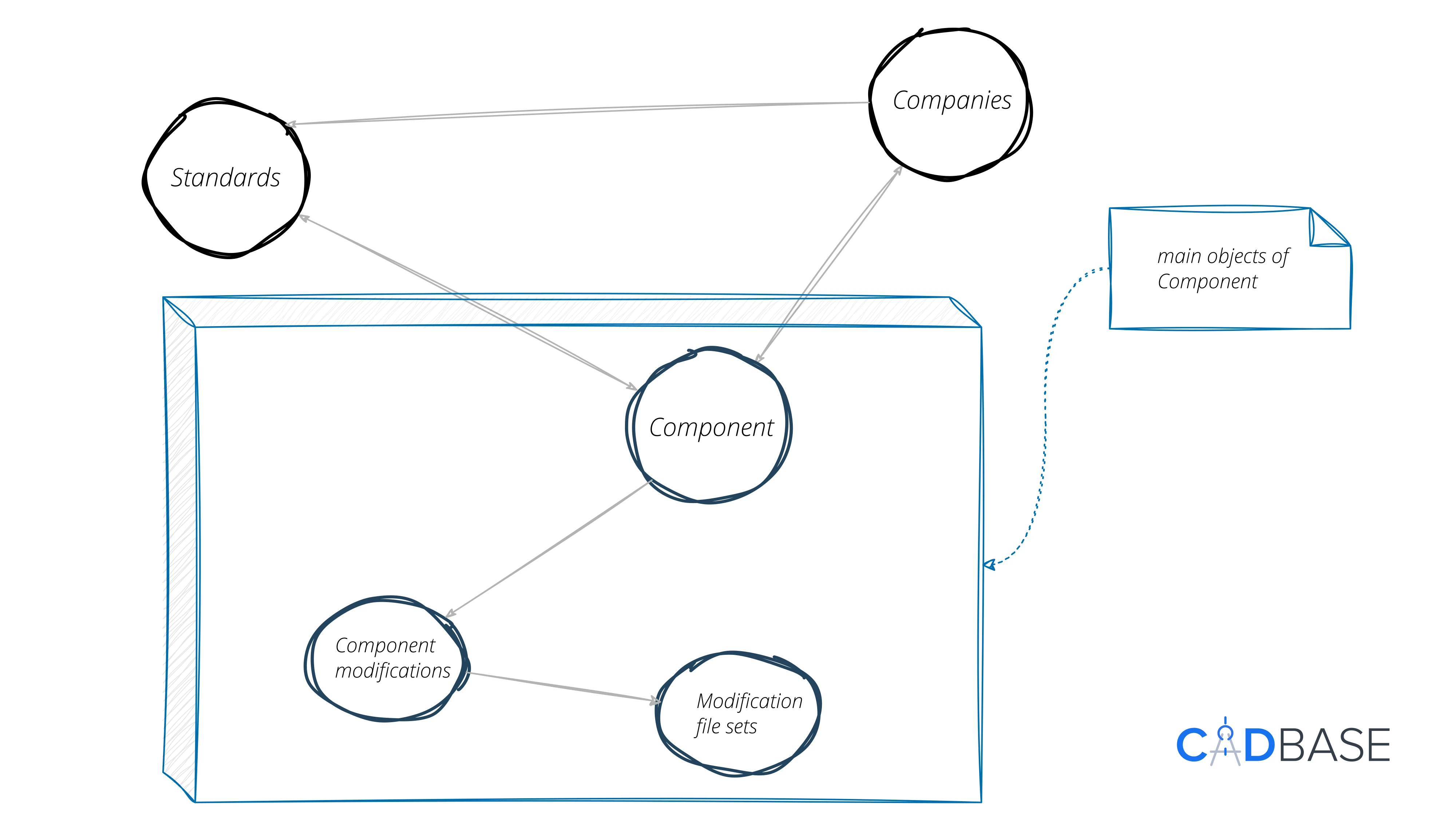
The main structural element of the platform is the Component — a data unit containing all information about a product, material, or equipment.
Each component includes:
- Attributes and files — core parameters and related documents.
- Modifications — component versions with attached design documentation, specifications and related documents.
- File sets — file groups for CAD systems (FreeCAD), 3D editors (Blender) and other specialized software.
- Standards — regulatory documents: industry standards (ISO, DIN) and corporate standards.
- Manufacturers and suppliers — component availability information.
- Catalogs — thematic collections of components.
- Tags — keywords for categorization and search.
- Material: steel, aluminum, plastic.
- Type: fastener, reinforcement, connection.
- Industry: construction, mechanical engineering.
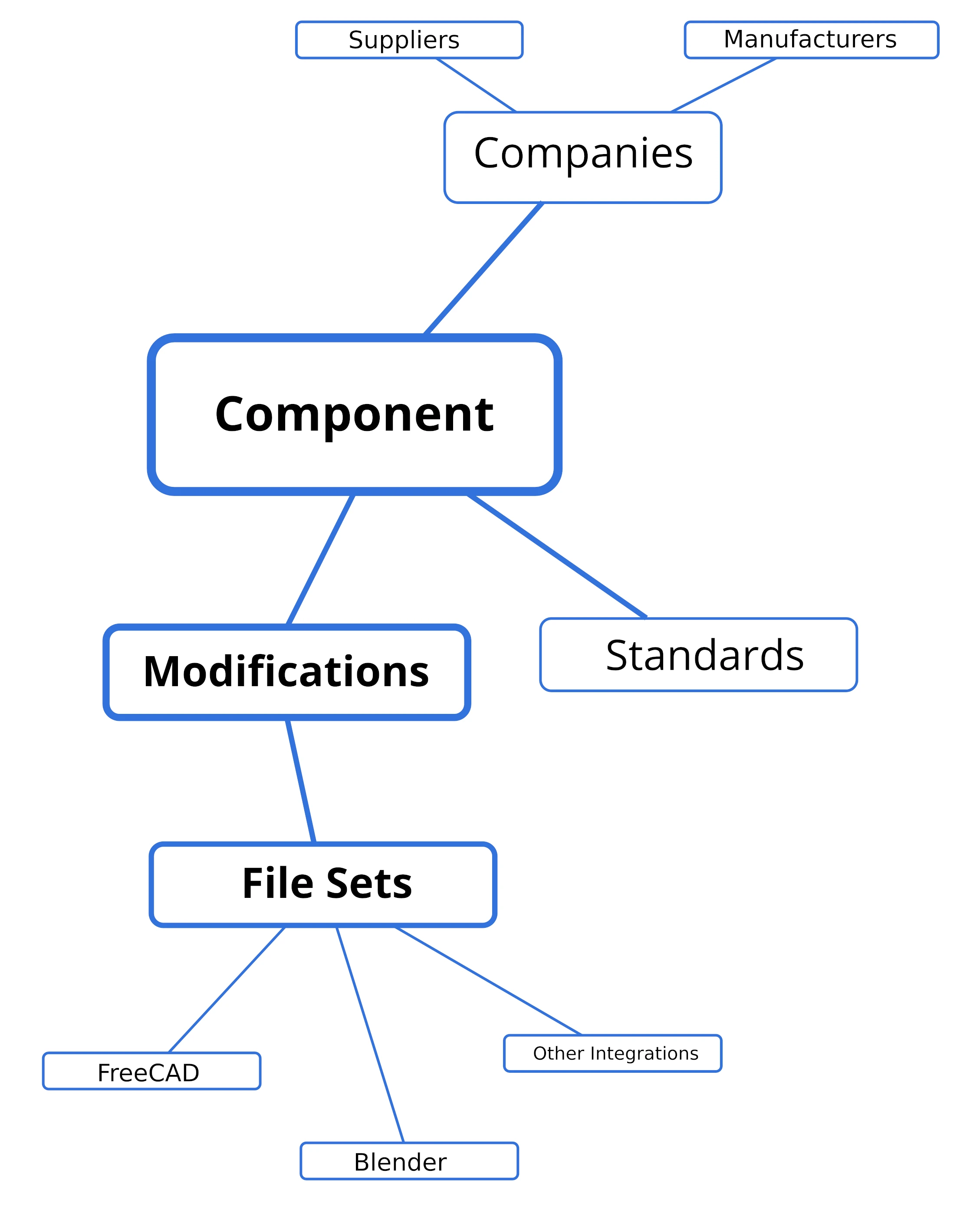
Platform Data Structure
Currently, the platform's website is available in Russian, Chinese, and English.
Technology stack
CADBase is written in Rust using WASM and WebGPU. The platform and the libraries it uses (OCCT, Three.js, and others) are distributed under free licenses, so there are no licensing fees.
Advantages over similar platforms
Similar products already exist, so we're constantly looking for improvements. CADBase currently combines several advantages:
- Easy integration with third-party software
- Selected user components and file sets are used to define components and data from third-party programs to interact with. For example, when working through the CADBase Library workbench in FreeCAD, the user will have only the necessary data updated.
- Creation of websites based on CADBase platform
- With branding, adding commodity calculations and creating add-ons for other programs, including those with limited API access. This is facilitated by access to the API of the platform server by any user of the platform, as well as distribution of the source codes of the platform and related projects under free licenses.
- File versioning
- File version control can help users and organizations improve data management strategies. A new version is created by uploading a file with the same name as a previously uploaded file. Users can revisit older versions as files evolve. In some cases, users prefer to retain certain versions.
- Granular access control
- The read/write access differentiation feature allows some users to be granted modification access and others to be granted read-only access. If access is granted to a company, its members will be granted access depending on their role in the company.
- Manufacturer and supplier info
- This allows companies that are distributors of standard industrial products to add themselves to component supplier lists.